

Chronic elbow pain disrupts daily routines for countless American adults, with many in Austin searching for long-term solutions instead of temporary relief. Ignoring persistent symptoms can lead to lasting damage and limit the activities you enjoy most. By understanding how to properly assess your elbow condition and find a board-certified orthopedic surgeon with advanced upper extremity training, you position yourself for more effective treatment and proven recovery outcomes.
Table of Contents
- Step 1: Assess Your Elbow Condition And Surgical Needs
- Step 2: Research Board-Certified Orthopedic Specialists
- Step 3: Verify Credentials And Fellowship Training
- Step 4: Review Patient Testimonials And Success Stories
- Step 5: Schedule Consultations And Evaluate Communication
Quick Summary
| Key Insight | Explanation |
|---|---|
| 1. Document Your Elbow Symptoms | Keep a detailed record of pain, movement issues, and history for a clearer assessment by your surgeon. |
| 2. Verify Surgeon Credentials | Ensure your orthopedic specialist has board certification and relevant fellowship training to ensure expertise. |
| 3. Review Patient Testimonials | Understand surgeon performance through real patient experiences, focusing on recovery times and satisfaction rates. |
| 4. Schedule Consultations | Use consultations to assess the surgeon’s communication style and their approach to your specific concerns. |
| 5. Evaluate Communication Quality | Pay attention to how well the surgeon explains conditions and options, ensuring a collaborative treatment approach. |
Step 1: Assess your elbow condition and surgical needs
Identifying whether you require surgical intervention for your elbow condition involves a strategic and comprehensive evaluation of your symptoms, medical history, and current functional limitations. The process demands careful assessment and professional guidance to determine the most appropriate treatment pathway.
Begin by documenting your specific elbow symptoms in detail. Track the frequency and intensity of your pain, noting whether it occurs during movement, at rest, or after specific activities. Consider range of motion challenges and any weakness or instability you experience. Identifying key injury symptoms becomes crucial in understanding the potential severity of your condition. Collect medical records documenting previous treatments, imaging results like X-rays or MRIs, and a chronological history of your elbow issues. This documentation will provide your orthopedic surgeon with a comprehensive view of your condition.
Consult with a board certified upper extremity specialist who can perform a thorough physical examination and assess whether surgical intervention or alternative treatments like PRP therapy might be most appropriate. Your surgeon will evaluate diagnostic imaging, discuss potential non surgical options, and help you understand the expected outcomes and recovery trajectory for your specific elbow condition.
Pro tip: Always prepare a detailed written summary of your symptoms and medical history before your initial consultation to help your surgeon conduct a more precise evaluation.
Here is a summary of common elbow symptoms and their importance for surgical evaluation:
| Symptom Type | Impact on Treatment | Why It Matters |
|---|---|---|
| Persistent pain | Indicates severity | Guides need for intervention |
| Limited mobility | Affects daily tasks | Reveals functional deficits |
| Instability | Signals damage | Points to possible surgery |
| Weakness | Impacts function | Assesses intervention scope |
Step 2: Research board-certified orthopedic specialists
Researching the right orthopedic specialist requires a strategic approach to ensure you find a surgeon with exceptional expertise in elbow conditions. Your goal is to identify a board-certified professional who not only has advanced surgical skills but also demonstrates a comprehensive understanding of upper extremity treatments.

Start by verifying the surgeon’s board certification through the American Board of Orthopaedic Surgery, which confirms they have met rigorous professional standards. Advanced orthopedic care techniques are crucial in determining a specialist’s capability to address complex elbow conditions. Look for surgeons who focus specifically on upper extremity treatments, particularly those with fellowship training in shoulder, elbow, and hand surgery. Review their professional credentials, including medical school, residency programs, and any additional specialized training in orthopedic subspecialties.
Examine the surgeon’s clinical experience by reviewing patient testimonials, surgical success rates, and their approach to innovative treatments like PRP therapy. Check if they are affiliated with reputable medical institutions and whether they actively participate in research or medical conferences related to orthopedic surgery. Professional memberships in organizations like the American Society for Surgery of the Hand or the American Academy of Orthopaedic Surgeons can indicate a commitment to ongoing professional development and cutting-edge medical knowledge.
Pro tip: Request a detailed consultation where you can discuss the surgeon’s specific experience with elbow conditions similar to yours and understand their treatment philosophy before making a final decision.
Step 3: Verify credentials and fellowship training
Confirming a surgeon’s credentials goes beyond simply checking their medical degree. You want to ensure that your potential elbow specialist has undergone comprehensive and specialized training specific to upper extremity surgical techniques.
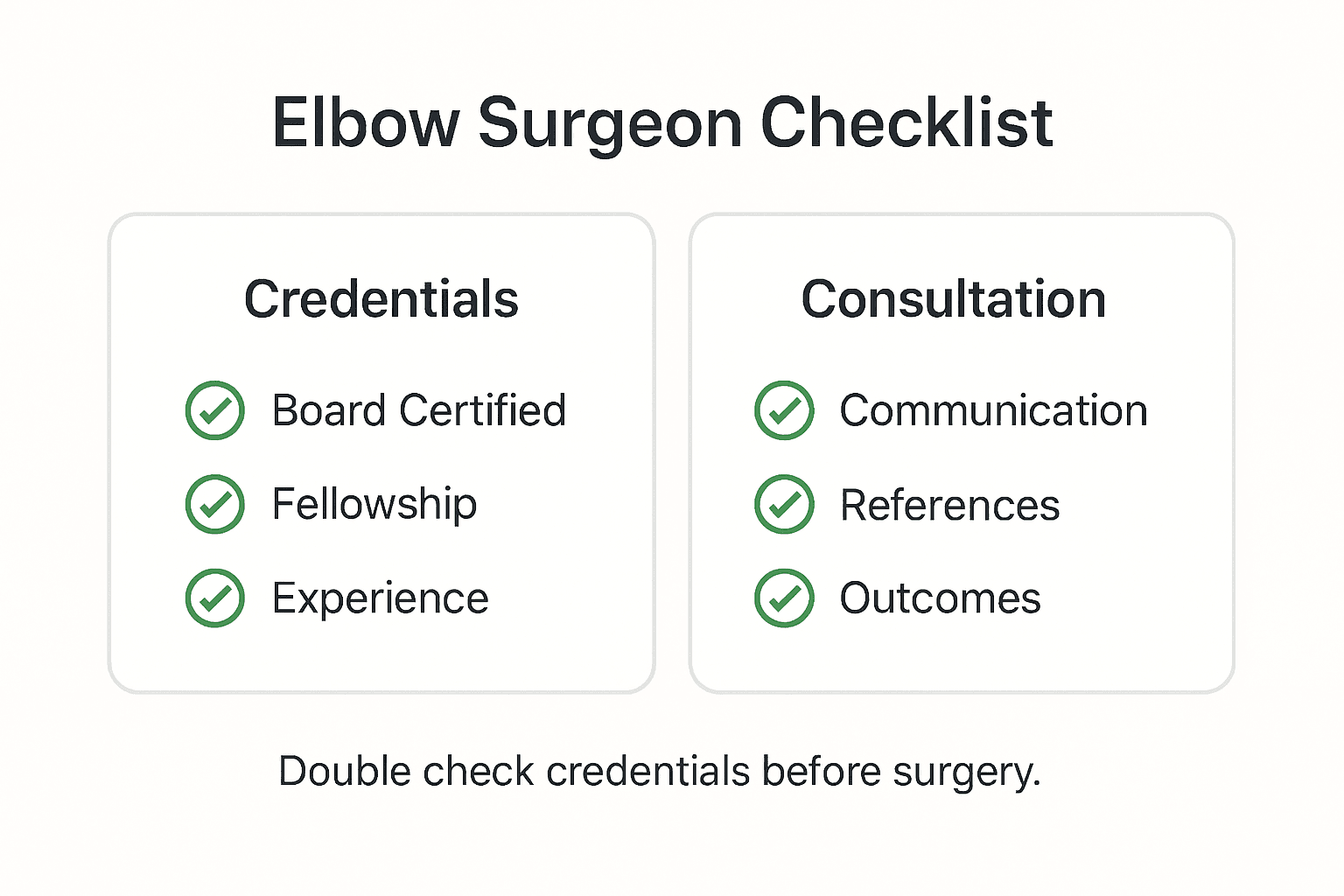
Specialized fellowship training in shoulder and elbow surgery represents a critical marker of advanced expertise that sets top orthopedic surgeons apart. Investigate whether the surgeon has completed an accredited fellowship program specifically focused on hand, wrist, elbow, and shoulder procedures. This additional training demonstrates a deep commitment to mastering complex surgical interventions beyond standard orthopedic residency. Request documentation of their fellowship credentials, including the institution where they trained, the specific focus of their advanced studies, and any research or publications that highlight their specialized knowledge.
Carefully review the surgeon’s board certifications from recognized organizations like the American Board of Orthopaedic Surgery. Look for additional professional memberships in specialized societies such as the American Society for Surgery of the Hand or the American Academy of Orthopaedic Surgeons. These credentials indicate ongoing professional development and a commitment to staying current with the latest surgical techniques and treatment approaches, including innovative options like PRP therapy for elbow conditions.
Pro tip: Request copies of the surgeon’s fellowship completion certificate and verify their credentials directly with the issuing professional boards to ensure complete authenticity.
This table compares credentials you should verify when choosing an orthopedic elbow specialist:
| Credential Type | What to Check | Professional Impact |
|---|---|---|
| Board Certification | Valid credentials, ABOS | Confirms expertise |
| Fellowship Training | Accredited programs, focus | Shows specialized skills |
| Society Membership | AAOS, ASSH, others | Indicates continued learning |
| Published Research | Surgery-related studies | Demonstrates innovation |
Step 4: Review patient testimonials and success stories
Patient testimonials provide invaluable insights into a surgeon’s actual performance beyond clinical credentials. These real world experiences offer a nuanced understanding of what you can genuinely expect during your surgical journey and recovery process.
Patient success stories in elbow surgical outcomes reveal critical information about potential surgical results. Pay close attention to testimonials that discuss specific details such as recovery time, pain management, range of motion improvements, and overall satisfaction with the surgical experience. Look for consistent themes across multiple patient stories that demonstrate the surgeon’s expertise in handling complex elbow conditions. Consider seeking out testimonials from patients with similar age groups, activity levels, and specific elbow conditions to yours. Some surgeons might provide video testimonials or written accounts that can offer deeper insights into their treatment approach and patient care philosophy.
Request detailed references and contact information for patients willing to share their experiences directly. Examine not just the successful outcomes but also how the surgeon managed potential complications or challenges during treatment. Research studies showing patient satisfaction rates and long term functional outcomes can complement individual testimonials, providing a more comprehensive view of the surgeon’s capabilities. Pay particular attention to patient experiences with innovative treatments like PRP therapy and their overall satisfaction with non surgical and surgical intervention strategies.
Pro tip: Request a curated list of patient references from your potential surgeon and prepare a set of specific questions about their surgical experience and recovery process before making contact.
Step 5: Schedule consultations and evaluate communication
Scheduling consultations is a critical step in finding the right elbow surgeon. These initial meetings provide an opportunity to assess not just the surgeon’s technical expertise but also their communication style and patient care approach.
Effective surgical communication strategies are essential in determining whether a surgeon will meet your comprehensive medical needs. During the consultation, pay close attention to how thoroughly the surgeon explains your condition, potential treatment options including non surgical approaches like PRP therapy, and expected outcomes. Observe whether they actively listen to your concerns, answer questions with clarity, and demonstrate genuine empathy. Prepare a list of specific questions about your elbow condition, potential surgical interventions, recovery timeline, and expected functional improvements.
Evaluate the surgeon’s communication beyond the initial consultation by assessing their support team’s responsiveness and professionalism. Consider factors such as how quickly they return calls, the comprehensiveness of their medical explanations, and their willingness to discuss alternative treatment options. A skilled surgeon should provide transparent information about potential risks, recovery expectations, and be open to discussing your specific concerns. Look for signs of a collaborative approach that involves you in the decision making process and demonstrates a commitment to personalized patient care.
Pro tip: Bring a trusted friend or family member to your consultation who can take notes and provide an objective perspective on the surgeon’s communication and recommendations.
Find the Right Elbow Surgeon for Your Healing Journey
Choosing the perfect elbow surgeon involves understanding your unique condition and finding a specialist who blends advanced skills with compassionate care. If you face persistent pain, limited mobility, or instability, you deserve a surgeon who offers personalized treatment plans and proven expertise to restore your function and comfort. This article guides you through assessing symptoms, verifying credentials, and evaluating patient testimonials to make the best decision for your recovery.
At Austin Hand To Shoulder, Dr. Manish V. Patel provides board-certified, fellowship-trained care focused on upper extremity conditions including complex elbow issues. Explore in-depth insights on Elbow Pain & Treatment Articles | Austin Orthopedic Care to understand your options better.
Take control of your health today by consulting with a trusted specialist who prioritizes your healing with personalized attention and the latest surgical techniques. Visit Austin Hand To Shoulder now to schedule your consultation and access expert guidance tailored to your elbow needs. Learn more about comprehensive treatments in the Orthopedic Care Archives and empower yourself with knowledge to make informed decisions.
Frequently Asked Questions
How can I assess if I need surgery for my elbow condition?
To determine if you need surgery for your elbow condition, document your symptoms, pain levels, and any functional limitations. Schedule a consultation with an orthopedic specialist to discuss your findings and receive a thorough examination.
What qualifications should I look for in an elbow surgeon?
Look for board certification from the American Board of Orthopaedic Surgery and specialized fellowship training in elbow, hand, and shoulder surgery. Verify these credentials and focus on surgeons with experience handling conditions similar to yours.
How do I review patient testimonials for an elbow surgeon?
To review patient testimonials, visit the surgeon’s website or request patient references during your consultation. Pay attention to details about recovery times and satisfaction rates to get a clearer understanding of their surgical performance.
What questions should I ask during my consultation with an elbow surgeon?
During your consultation, ask about their experience with your specific elbow condition, treatment options, and expected outcomes. Prepare a list of questions so you can assess their communication style and approach to care.
Why is it important to verify a surgeon’s fellowship training?
Verifying a surgeon’s fellowship training is crucial because it indicates advanced expertise in surgical techniques specific to elbow conditions. It ensures that your surgeon has received specialized training beyond standard medical education and is qualified to perform complex procedures.
How do I evaluate the communication style of an elbow surgeon?
Evaluate the communication style of your elbow surgeon during your consultation by noting how attentively they listen to your concerns and explain potential treatment options. A good surgeon should provide clear, empathetic responses and encourage a dialogue about your treatment plan.
Recommended
- When Is Elbow Surgery Necessary? Complete Guide – Austin Hand To Shoulder
- Elbow Doctor Austin: Complete Guide to Local Care – Austin Hand To Shoulder
- Elbow Surgery Austin TX | Tennis & Golfers Elbow | Dr. Patel
- Understanding Elbow Anatomy Explained: A Comprehensive Overview – Austin Hand To Shoulder


