

Only about 0.2 percent of all wrist injuries in the american population are true wrist dislocations, making them a rare challenge even for trained professionals. Misunderstandings about these injuries often lead to confusion with more common sprains or fractures, which can delay proper care. This article brings clarity by breaking down the real facts, common risk factors, and what every american should know about wrist dislocations to help prevent confusion and support better outcomes.
Table of Contents
- Defining Wrist Dislocation And Misconceptions
- Types Of Wrist Dislocations And Severity Levels
- Traumatic Versus Non-Traumatic Causes Explained
- Common Risk Factors And Contributing Activities
- Associated Injuries And Potential Complications
Key Takeaways
| Point | Details |
|---|---|
| Wrist Dislocations Are Rare | Isolated wrist dislocations occur in only 0.2% of wrist injuries, leading to diagnostic challenges and potential mismanagement. |
| Types and Classifications | Wrist dislocations are categorized into types like radiocarpal and midcarpal, and severity levels range from stable to significant treatment challenges. |
| Traumatic vs. Non-Traumatic Causes | Dislocations can be caused by high-energy impacts or conditions like congenital anomalies and degenerative diseases, necessitating tailored treatment. |
| Associated Injuries and Complications | Wrist dislocations often involve additional injuries such as fractures or nerve damage, emphasizing the need for prompt medical evaluation and intervention. |
Defining Wrist Dislocation and Misconceptions
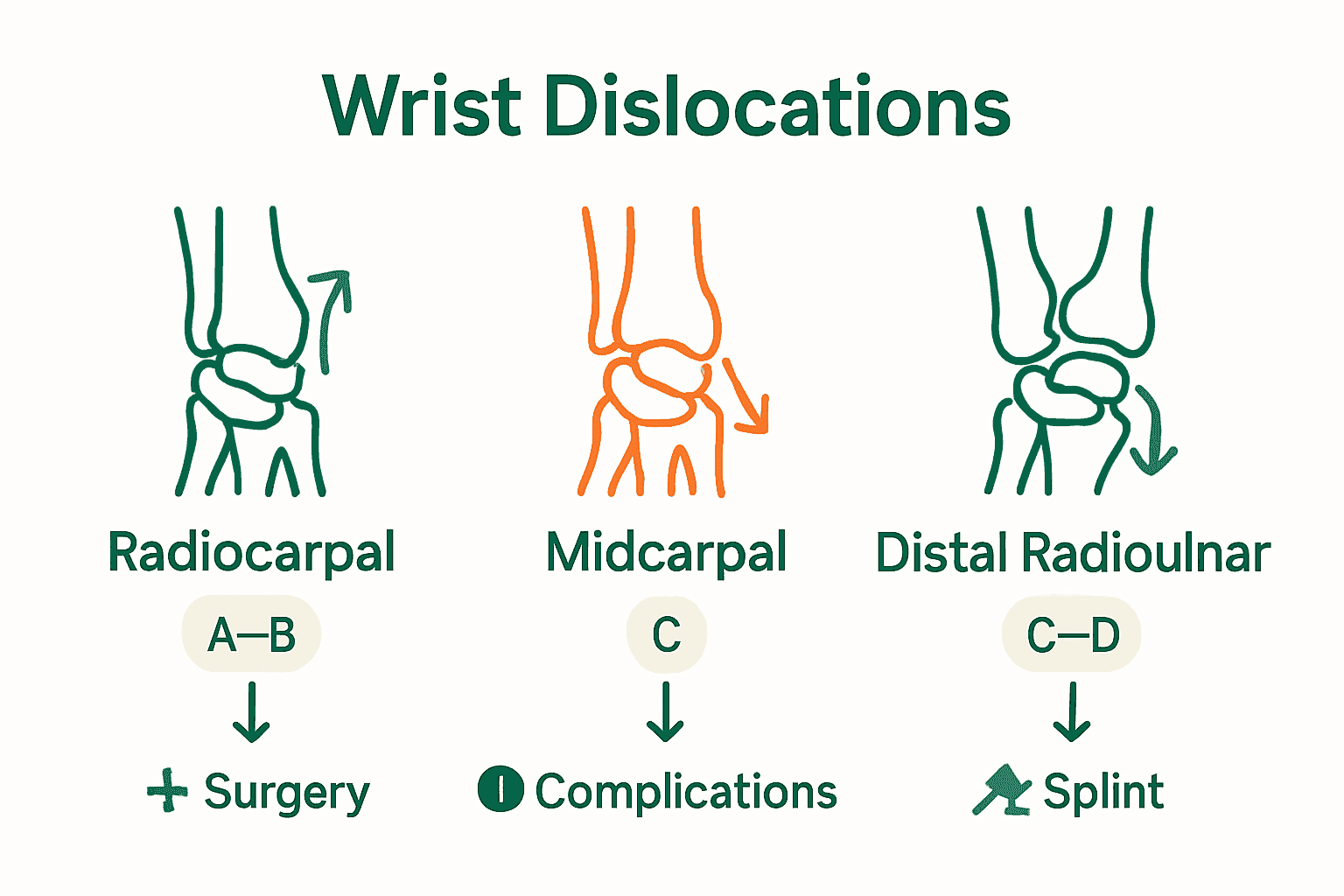
A wrist dislocation represents a complex and rare orthopedic condition involving complete separation of joint surfaces within the intricate wrist anatomy. According to PubMed, these injuries can occur across multiple joint locations including the radiocarpal, midcarpal, and distal radioulnar regions, making them challenging to diagnose and treat.
Contrary to common misconceptions, wrist dislocations are extraordinarily uncommon medical events. Research indicates that isolated wrist dislocations comprise merely 0.2% of all wrist injuries, which contributes significantly to diagnostic challenges Academic Research. Many patients and even some healthcare professionals mistakenly conflate wrist dislocations with sprains or fractures, leading to potential mismanagement of these complex injuries.
The complexity of wrist anatomy plays a crucial role in understanding these dislocations. The human wrist contains eight small carpal bones arranged in two intricate rows, connected by multiple ligaments and soft tissue structures. When a dislocation occurs, these delicate interconnections are disrupted, potentially causing severe pain, immediate functional impairment, and risk of long-term joint instability.
 Patients experiencing sudden wrist trauma should seek immediate professional medical evaluation, preferably from a specialist trained in wrist surgeries and their specific uses.
Recognizing the nuanced nature of wrist dislocations requires understanding that each case presents unique challenges. Professional medical imaging and expert orthopedic assessment remain the gold standard for accurate diagnosis and appropriate treatment planning. Potential interventions might range from manual reduction and immobilization to surgical reconstruction, depending on the specific joint involvement and severity of the injury.
Types of Wrist Dislocations and Severity Levels
According to PubMed, wrist dislocations can be systematically categorized based on the specific anatomical joint involved: radiocarpal, midcarpal, and distal radioulnar joints. Each type of dislocation presents unique challenges in diagnosis and treatment, with variations in complexity and potential long-term implications for joint function and patient mobility.
WakeMed Orthopaedics provides a comprehensive classification system that breaks down wrist dislocations and associated fractures into four critical severity levels:
- Type A: Stable acute injuries with minimal joint displacement
- Type B: Unstable fractures and dislocations requiring immediate intervention
- Type C: Injuries with delayed healing potential
- Type D: Nonunion or fibrous union fractures presenting significant treatment challenges
Understanding these nuanced classifications is crucial for patients seeking comprehensive treatment options. For individuals interested in exploring additional insights about hand and wrist conditions, our guide to hand and wrist conditions offers comprehensive information. Professional medical assessment remains essential, as each dislocation presents unique characteristics that demand personalized diagnostic and treatment approaches.
Traumatic Versus Non-Traumatic Causes Explained
According to PubMed, wrist dislocations can be fundamentally categorized into two primary groups: traumatic and non-traumatic causes. Traumatic dislocations typically result from high-energy impacts such as motor vehicle accidents, sports-related injuries, workplace incidents, or sudden falls that generate significant force and unexpected joint stress.
International Federation of Societies for Surgery of the Hand research reveals that carpal instability leading to wrist dislocations encompasses a complex spectrum of causative factors. Non-traumatic causes often involve more subtle mechanisms:
- Congenital anomalies affecting joint structural integrity
- Degenerative conditions that progressively weaken ligament connections
- Chronic inflammatory diseases impacting joint stability
- Neurological disorders compromising muscular support around the wrist
Understanding these nuanced origins is critical for developing targeted treatment strategies.
VIDEO:video_content] For patients seeking comprehensive insights into hand and wrist conditions, our [guide to hand and wrist conditions provides additional context. Professional medical evaluation remains paramount, as each dislocation represents a unique constellation of anatomical, physiological, and biomechanical factors that demand personalized diagnostic approaches.
Common Risk Factors and Contributing Activities
According to PubMed, several key risk factors significantly increase an individual’s susceptibility to wrist dislocations. High-impact sports, repetitive wrist motions, and previous wrist injuries emerge as primary contributors to potential joint instability. Athletes participating in gymnastics, football, and contact sports face substantially higher risks of experiencing traumatic wrist injuries that can lead to dislocations.
Academic Research highlights that wrist injuries frequently occur in unexpected scenarios, with falls on an outstretched hand representing a particularly common mechanism of injury. The most prevalent contributing activities include:
- Competitive and recreational sports
- Manual labor occupations
- Construction and industrial work
- Extreme physical activities
- Motor vehicle accidents
- Home-based accidents involving sudden force
Individuals with occupations or lifestyles involving repetitive wrist stress should pay special attention to early warning signs and preventative measures. For those seeking comprehensive understanding of potential hand and wrist conditions, our guide to hand and wrist conditions offers valuable insights. Professional medical consultation remains crucial for personalized risk assessment and preventative strategies tailored to individual physical demands and predispositions.
Associated Injuries and Potential Complications
PubMed research reveals that wrist dislocations are rarely isolated incidents, often involving a complex network of associated injuries. These can include severe ligament tears, fractures, and nerve damage that significantly impact long-term joint function and patient recovery. The interconnected nature of wrist anatomy means that a single dislocation can trigger a cascade of potential complications affecting multiple anatomical structures.
According to specialized medical research, PubMed highlights several critical potential complications, particularly with perilunate dislocations:
- Median nerve compression
- Avascular necrosis of the lunate
- Long-term functional impairment
- Chronic pain syndromes
- Reduced range of motion
- Post-traumatic arthritis
Professional medical intervention becomes paramount in preventing these serious long-term consequences. Patients experiencing wrist trauma should seek immediate evaluation, particularly those with wrist fractures that might be misdiagnosed. Early diagnosis and comprehensive treatment can dramatically reduce the risk of permanent disability and ensure optimal recovery potential. Each injury represents a unique medical challenge demanding personalized, expert-level assessment and targeted rehabilitation strategies.
Expert Care for Wrist Dislocations Starts Here
Wrist dislocations are complex injuries that involve multiple joints and delicate ligaments. This condition can result in severe pain, loss of function, and potential long-term complications like nerve damage or arthritis if not treated promptly and expertly. If you or a loved one face this challenge, understanding your injury and finding the right treatment plan is crucial. Our detailed Wrist Injury & Treatment Guides | Austin Orthopedic Blog provide valuable insights tailored to help you navigate these complex conditions.

Don’t let wrist pain or instability hold you back any longer. At handtoshoulderaustin.com, Dr. Manish V. Patel offers fellowship-trained, board-certified expertise in upper extremity care. With personalized treatment plans that focus on rapid recovery and long-term joint stability you can regain strength and function. Take charge of your wrist health today by scheduling a consultation with our team. Learn more about related conditions in our Sports Medicine & Athlete Care | Austin Orthopedic Blog or explore other hand and wrist topics on our main site. Your best recovery starts with the right specialist and the right information.
Frequently Asked Questions
What are the main causes of wrist dislocation?
Wrist dislocations can be caused by traumatic events such as high-energy impacts from sports injuries or falls, as well as non-traumatic factors like congenital anomalies, degenerative conditions, chronic inflammation, and neurological disorders.
How can I differentiate between a wrist dislocation and a sprain or fracture?
Wrist dislocations involve the complete separation of joint surfaces, often presenting with severe pain and immediate functional impairment. In contrast, sprains may cause ligament damage without dislocation, and fractures usually involve a break in a bone. Proper medical imaging is essential for accurate diagnosis.
What are the common symptoms of a wrist dislocation?
Common symptoms of a wrist dislocation include severe pain, swelling, visible deformity, immediate loss of function, and in some cases, numbness or tingling if nerves are affected.
What should I do if I suspect a wrist dislocation?
If you suspect a wrist dislocation, seek immediate medical evaluation from a healthcare professional, preferably one specialized in wrist injuries, to receive accurate diagnosis and appropriate treatment.
Recommended
- Wrist Fractures Misdiagnosed: Complete Guide – Austin Hand To Shoulder
- Wrist Fracture Management: Step-by-Step Recovery Guide – Austin Hand To Shoulder
- 7 Common Examples of Wrist Surgeries and Their Uses – Austin Hand To Shoulder
- Wrist Pain Self-Care Guide for Fast Relief at Home – Austin Hand To Shoulder


